
SCHÖNBRUNN PALACE HISTORY & FACTS
Schönbrunn Palace and Gardens
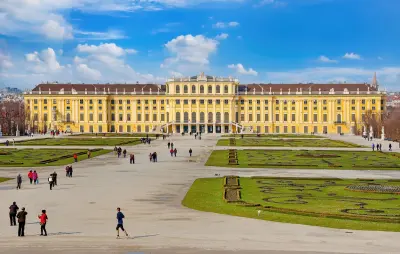
Schönbrunn Palace, located in the 13th district of Vienna, Austria, has a rich history dating back several centuries. Originally built as a hunting lodge, it evolved into one of Europe’s most magnificent Baroque palaces. It was the main summer residence of the Habsburg dynasty and witnessed many historical, political, and cultural changes over the past centuries. Today, the 1441-room Grand Baroque palace is one of the most important monuments in Austria, a world heritage site, and a main tourist attraction.

Early history
The history of Schönbrunn dates back to the Middle Ages. The site of Schönbrunn, known as the Katterburg since the early 14th century, had various tenants over the centuries. In 1569, the area came into the possession of the Habsburg family through Holy Roman Emperor Maximilian II. The large piece of land near the Wien River between Meidling and Hietzing included a house, a watermill, stables, and a garden and was used as a hunting retreat. The Emperor fenced the estate and filled it with animals for hunting.

“Beautiful spring”
The name Schönbrunn, meaning “beautiful spring” in German, first appeared in 1642 in some official documents. After Emperor Ferdinand II’s death in 1637, his widow, Eleonora Gonzaga, built a new residence at Schönbrunn between 1638 and 1643 and renamed the estate. The site remained a private retreat until Emperor Leopold I decided in 1686 to build a grand palace for his son, Joseph.

From the hunting lodge to the imperial residence
Architect Johann Bernhard Fischer von Erlach presented plans for a new palace at Schönbrunn in 1688, and construction began in 1696. The palace was built on the ruins of the previous building that had been destroyed by the Turks. The progress was slow, with delays due to war and financial issues, especially after the death of Joseph I. The unfinished palace became the residence of Wilhelmine Amalie, who decorated the walls with portraits of horses, now displayed in the “Rösselzimmer” (Horse Room).

Transformation under Empress Maria Theresa
Emperor Charles VI obtained the palace in 1728 but only used it for hunting purposes. Eventually, he gave it as a present to his daughter Maria Theresa. Maria Theresa’s reign marked the beginning of a new era for Schönbrunn, with the palace becoming the center of the royal court and political life. Under Empress Maria Theresa, Schönbrunn Palace was expanded and transformed into an imperial residence. Architect Nikolaus Pacassi redesigned it in Baroque style, adding new wings, rooms, and a theater. Renovations took place in two phases: 1743-1749, which expanded the emperor’s apartments and added colonnades, and 1752-1765, which focused on decorating ceremonial rooms. The palace became a center for royal events and a symbol of Habsburg power, and Maria Theresa used it to show off the empire’s influence. After her husband, Emperor Franz I, died in 1765, she made further changes and expansions.
Want to learn more about the history of Schönbrunn Palace?

A tour of the Palace and its gardens
Schönbrunn Palace Imperial Tour
Skip the lines and visit the 22 most important rooms in Schönbrunn Palace. Join a small group tour and explore highlights like the Great Gallery, The Millions Room, the Lantern Room, the Hall of Mirrors, and the Hunting Room. See Empress Maria Theresa and Sisi's lavishly decorated private rooms. Your guide will share exciting stories about Emperor Franz Joseph and the Habsburg royal family's luxurious lifestyle. Walk through the landscaped gardens, and visit the Gloriette for beautiful views of the palace and the city.

Personalized & flexible tour option
Schönbrunn Palace Private Tour
Experience a VIP private tour of Schönbrunn Palace with a professional guide. Enjoy a personalized journey through the palace's beautifully decorated rooms and gardens with dedicated attention. Learn about the palace's rich history and hear interesting stories about the Habsburg dynasty, Empress Maria Theresa, and Empress Sisi. Relax in the manicured gardens, explore the Roman Ruins, and visit the Gloriette for panoramic views of the palace and Vienna. Discover the beauty and history that make Schönbrunn unforgettable.

The Treaty of Schönbrunn
After Maria Theresa’s death, Schönbrunn was unoccupied until Emperor Franz II/I used it as a summer residence. During the Napoleonic Wars, Napoleon occupied the palace twice, in 1805 and 1809, using the memorial rooms as his quarters and a base for negotiations. On October 14, 1809, the Treaty of Schönbrunn was signed there, marking the end of the Austrian War of Liberation against Napoleon.
The Congress of Vienna
During the Congress of Vienna (1814-1815), Schönbrunn Palace hosted informal meetings and social events, highlighting Austria’s power and role in shaping post-Napoleonic Europe. Between 1817 and 1819, Emperor Franz I/II redesigned the facade. Architect Johann Aman replaced Rococo decorations with a simpler style, painting the palace in “Schönbrunn Yellow”, its current color.

Emperor Franz Joseph
Franz Joseph, the longest-reigning Emperor of Austria, was born at Schönbrunn and spent much of his life there. In preparation for his 1854 marriage to Elisabeth (Sisi), new apartments were created for her. The palace was renovated again for the 1873 World Exhibition. Emperor Franz Joseph lived in the West Wing of Schönbrunn until his death in 1916 at the age of 86.
End of monarchy in 1918
Following the end of World War I and the collapse of the Austro-Hungarian Empire, the Habsburg monarchy was abolished, and the newly established Republic of Austria nationalized the palace and turned it into a museum. The Habsburg family was exiled, and Schönbrunn was no longer an imperial residence.

Schönbrunn during World War II
In the early 20th century, the palace opened to the public as a museum. Its extensive rooms and gardens were preserved as historic sites and cultural landmarks. During World War II, Schönbrunn Palace was repurposed for military offices and delegations. The palace was damaged during the war but was spared from major damage.
Present day
Schönbrunn Palace was added to the UNESCO World Cultural Heritage List in 1996 for its historical, architectural, and cultural importance. The palace hosted numerous important events, both cultural and diplomatic, including the 1961 Vienna Summit, where U.S. President John F. Kennedy and Soviet Premier Nikita Khrushchev held discussions during the Cold War. Schönbrunn continues to play a role as both a historic site and an active venue for state functions, classical concerts, and events. Since 1992, a state-owned company has managed the palace and its preservation without government funding.
Discover Schönbrunn Palace on your own!

Skip-the-line
Schönbrunn Palace & Gardens Ticket
Skip the lines at Schönbrunn Palace and Gardens and explore its imperial history and grandeur. See the stunning Baroque architecture, luxurious palace rooms, and extensive gardens. Enjoy exclusive entry to 22 lavishly decorated imperial rooms. Discover the estate's manicured gardens, fountains, and the Gloriette. Learn about the rich history of the Habsburg dynasty and the opulent royal court life of Empress Sisi and Maria Theresa.

Quick way to explore Royal estate
Schönbrunn Panorama Train Ticket
Explore the beautiful Schönbrunn Palace Park by riding the Panoramabahn Schönbrunn. Hop on and off at any of the nine stops along the route. Enjoy the scenic drive through the landscaped gardens and stop for panoramic views of the palace and gardens from the iconic Gloriette. Visit attractions like the Orangery, The Maze, the Fountain of Neptune, the Rose Garden, the Palm House, and the Hunting Lodge. Take your time to discover the Park at your own pace and enjoy the perfect mix of nature, history, and stunning architecture.