
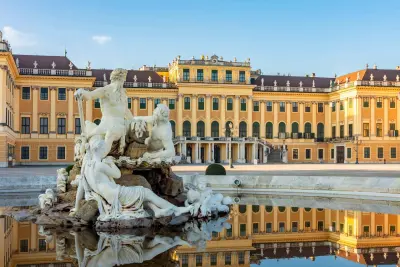
SCHÖNBRUNN PALACE ARCHITECTURE
About Schönbrunn Palace
The Schönbrunn Palace is a beautiful example of European Baroque architecture with its grand facade, symmetrical design, and intricate decorations. It was originally built as a hunting lodge by Emperor Maximilian II in the late 16th century. Under Empress Maria Theresa in the 18th century, it was expanded and transformed into the grand Baroque palace and was used as an imperial summer residence of the Habsburgs. The architecture of the palace combines classical European styles with Rococo influences. Today, the palace and gardens of Schönbrunn, which cover 160 hectares, are a UNESCO World Heritage site that preserves Austria’s royal history.

A Hunting lodge
Schönbrunn Palace was originally a hunting lodge built by Emperor Maximilian II in the late 16th century. The lodge was a simple residence with a house, a watermill, stables, and a garden. In the late 17th century, Emperor Leopold I expanded it into a grand Baroque residence designed by architect Johann Bernhard Fischer von Erlach. He combined Classical and Baroque styles with a central axis, a main structure, a large stairway, wings for stables, and a parade court. The Staterooms faced the parade court, with Joseph I’s private suite in the West Wing, guest rooms in the East Wing, and the Empress Stairway leading to the Empress’s apartments. Under Emperor Charles VI, architect Giovanni Pietro Tencalla designed the landscape around the palace.

Transformation under Maria Theresa
After Emperor Charles VI’s death, his daughter Maria Theresa transformed Schönbrunn into a grand summer residence. Architect Nikolaus Pacassi oversaw the palace’s expansion, and court architect Johann Aman added Baroque and Rococo elements to the interior and gardens. The exterior and gardens followed the Baroque symmetry, with Italian and French influences. The gardens included formal pathways, fountains, and sculptures. Following Maria Theresa’s death, her son Joseph II introduced simpler, more functional designs. In the 19th century, Neoclassical styles prevailed, and under Emperor Franz Joseph, the palace underwent restoration and expansion, with the addition of new imperial apartments and improvements to the gardens.

1441 rooms inside the palace
Schönbrunn Palace has 1441 rooms, including two main wings of the palace, the West Wing and East Wing, which are connected by the central structure. These wings house imperial apartments and guest rooms and contribute to the symmetrical Baroque design. The palace includes grand State Apartments, private rooms for the royal family, the Million Room, Mirror Room, music and dining rooms, ballrooms, guest quarters, servants’ areas, and study rooms. The mix of Baroque, Rococo, and Neoclassical styles reflects the Habsburg dynasty’s wealth and grandeur while also providing private spaces for the royal family.

Schönbrunn and yellow color
The iconic yellow color of Schönbrunn Palace is one of its most distinctive features. The yellow facade was chosen after the Congress of Vienna to reflect elegance while giving the palace a warm, welcoming appearance. The renovation to simplify the facade and remove Rococo decorations, led by architect Johann Aman, took place between 1817 and 1819. The yellow facade became a symbol of the Habsburg family’s wealth, power, and influence, and it has remained a defining feature of Schönbrunn to this day.
Want to learn more about Schönbrunn Palace?

A tour of the Palace and its gardens
Schönbrunn Palace Imperial Tour
Skip the lines and visit the 22 most important rooms in Schönbrunn Palace. Join a small group tour and explore highlights like the Great Gallery, The Millions Room, the Lantern Room, the Hall of Mirrors, and the Hunting Room. See Empress Maria Theresa and Sisi's lavishly decorated private rooms. Your guide will share exciting stories about Emperor Franz Joseph and the Habsburg royal family's luxurious lifestyle. Walk through the landscaped gardens, and visit the Gloriette for beautiful views of the palace and the city.

Personalized & flexible tour option
Schönbrunn Palace Private Tour
Experience a VIP private tour of Schönbrunn Palace with a professional guide. Enjoy a personalized journey through the palace's beautifully decorated rooms and gardens with dedicated attention. Learn about the palace's rich history and hear interesting stories about the Habsburg dynasty, Empress Maria Theresa, and Empress Sisi. Relax in the manicured gardens, explore the Roman Ruins, and visit the Gloriette for panoramic views of the palace and Vienna. Discover the beauty and history that make Schönbrunn unforgettable.

The Grand Gallery
The Grand Gallery of Schönbrunn Palace is a stunning example of Baroque opulence. The gallery, designed by Nicolaus Pacassi for Empress Maria Therery, is 43 meters long and was made for large royal ceremonies and balls. It has large windows, crystal chandeliers, high ceilings with mythological frescoes, gilded stucco, and parquet floors, and it reflects Baroque ideals of symmetry, light, and decoration.
The Ceremonial Hall
The Ceremonial Hall, designed also under Empress Maria Theresa, was used for official ceremonies and royal events. The room features high ceilings with detailed stucco work, frescoes with allegorical themes, dramatic columns, gilded decorations, and crystal chandeliers.

The Millions Room
The Millions Room is one of the most luxurious in Schönbrunn Palace, designed to impress with its opulent Baroque style. Built during Empress Maria Theresa’s reign and named for its expensive decorations and materials, the room has walls with gold accents, a fresco with mythological themes, and richly coloured fabrics.
The Hall of Mirrors
The Hall of Mirrors is one of the palace’s most iconic and visually striking rooms. Designed in the mid-18th century under Empress Maria Theresa, it was initially used for royal ceremonies and entertainment. Its large gilded mirrors, crystal chandeliers, and reflective surfaces create a sense of space and light. The room reflects Baroque and Rococo styles, showing luxury and power.

Empress Maria Theresa’s Private Rooms
Empress Maria Theresa’s private rooms in Schönbrunn Palace are designed with Rococo decorations, emphasizing intimacy and comfort. These rooms offer a more personal, elegant atmosphere with soft pastel colors, delicate stucco work, and wood paneling. The rooms have rich tapestries, gilded mirrors, and soft frescoes, creating a luxurious yet intimate space.
Empress Sisi’s Rooms
Empress Sisi’s rooms reflect her personal style, with soft pastel colors, floral patterns, and modest furnishings, contrasting the grand state rooms. The rooms are designed with elements of Neoclassical and Rocco styles designed for comfort and privacy. The space highlights simplicity and intimacy, showing her preference for a more personal life away from royal formality.

The Schönbrunn Gardens
The gardens of Schönbrunn Palace are a prime example of Baroque landscape design. The gardens, designed by Johann Bernhard Fischer von Erlach, feature symmetrical paths, terraces, fountains, and statues. The layout emphasizes balance and order, with wide avenues leading toward the palace. Later developments were made by Nicolaus Pacassi and Hermann von Pückler-Muskau, including the creation of the Gloriette. The gardens show imperial power, wealth, and the connection between the palace and nature.
The Gloriette
The Gloriette at Schönbrunn is a grand structure built in 1775, designed by Johann Ferdinand Hetzendorf von Hohenberg in the Neoclassical style. It is located on a hill and offers panoramic views of the palace and Vienna. The Gloriette has an open colonnade, an arched roof, a central triumphal arch with ornate details, and a statue of eagles, symbolizing imperial Austria. Originally a victory monument and banquet hall, it represents the power of the Habsburgs and connects the palace with nature, serving as both a symbol and a space for relaxation.

The Orangery
Designed by Johann Bernhard Fischer von Erlach in the Baroque style, the Schönbrunn Orangery was completed in 1754. It was initially used to store citrus trees and other exotic plants during winter. The Orangery also hosted royal events and cultural performances. The building is long and rectangular, with large windows for light and a decorative facade with columns and sculptures. Today, it serves as a museum and exhibition space, symbolizing the Habsburg lifestyle and their love for gardens.
The Maze
The Maze at Schönbrunn Palace, built in 1698 by Nicolaus Jadot, is a Baroque labyrinth designed to entertain visitors of the royal court. Redesigned in the 19th century, it has winding paths, dead ends, and a tall tower with views of the gardens.
The Neptune Fountain
The Neptune Fountain, designed by Franz Anton Maulbertsch in 1777, is a striking Baroque feature and a highlight in the palace gardens. It is located near the Roman Ruins and shows the sea god Neptune surrounded by sea creatures and nymphs. The mighty statue of Neptune is made of limestone and marble, with intricate carvings, and symbolizes the power of the sea and the grandeur of the garden.
Looking to discover Schönbrunn at your own pace?

Skip-the-line
Schönbrunn Palace & Gardens Ticket
Skip the lines at Schönbrunn Palace and Gardens and explore its imperial history and grandeur. See the stunning Baroque architecture, luxurious palace rooms, and extensive gardens. Enjoy exclusive entry to 22 lavishly decorated imperial rooms. Discover the estate's manicured gardens, fountains, and the Gloriette. Learn about the rich history of the Habsburg dynasty and the opulent royal court life of Empress Sisi and Maria Theresa.

Quick way to explore Royal estate
Schönbrunn Panorama Train Ticket
Explore the beautiful Schönbrunn Palace Park by riding the Panoramabahn Schönbrunn. Hop on and off at any of the nine stops along the route. Enjoy the scenic drive through the landscaped gardens and stop for panoramic views of the palace and gardens from the iconic Gloriette. Visit attractions like the Orangery, The Maze, the Fountain of Neptune, the Rose Garden, the Palm House, and the Hunting Lodge. Take your time to discover the Park at your own pace and enjoy the perfect mix of nature, history, and stunning architecture.